
China Top 10 Industrial Floor Repair Mortar Manufacturers

Industrial Floor Repair Mortar is not merely a material for filling cracks. It helps restore worn concrete floors exposed to forklifts, pallet traffic, cleaning chemicals, and repeated impact. On a busy factory floor, even a shallow spall can catch a wheel and spread into a larger repair. Timing matters. So does preparation.

Concrete repair specialist Alex Morgan offers a practical rule: “A repair is only as dependable as the surface it bonds to.” That line captures a common site reality. Dust, oil, moisture, and weak concrete can undermine a patch before heavy traffic returns. Buyers should compare more than product names. They should examine bond strength, compressive strength, working time, curing requirements, and suitability for the actual floor conditions. A fast-setting mortar may reduce downtime, yet it can leave little room for careful placement. There is a trade-off.

This overview of China’s top 10 Industrial Floor Repair Mortar manufacturers is intended to help facility managers, contractors, and distributors assess potential suppliers. The comparison should consider product range, technical documentation, customization, quality controls, and support after purchase. A polished catalogue is useful, but it cannot replace clear test data or a sample evaluation. Rankings also have limits: factory capability and product performance can vary by formulation and project conditions. That deserves attention. A sensible shortlist starts with the repair problem, not the sales claim, and checks whether each mortar fits the required thickness, traffic, and reopening schedule. Even then, site results may differ. That is worth admitting.
China Top 10 Industrial Floor Repair Mortar Manufacturers

What Industrial Floor Repair Mortar Is and Where It Is Used

China Top 10 Industrial Floor Repair Mortar Manufacturers
What Industrial Floor Repair Mortar Is and Where It Is Used

Industrial floor repair mortar is a cement-based or resin-modified material used to restore damaged concrete. It can fill spalls, shallow holes, worn edges, and some cracks. Formulations vary in setting time, bond strength, chemical resistance, and permitted thickness. A fast-setting mix may reopen a loading bay sooner, but it still needs proper curing.

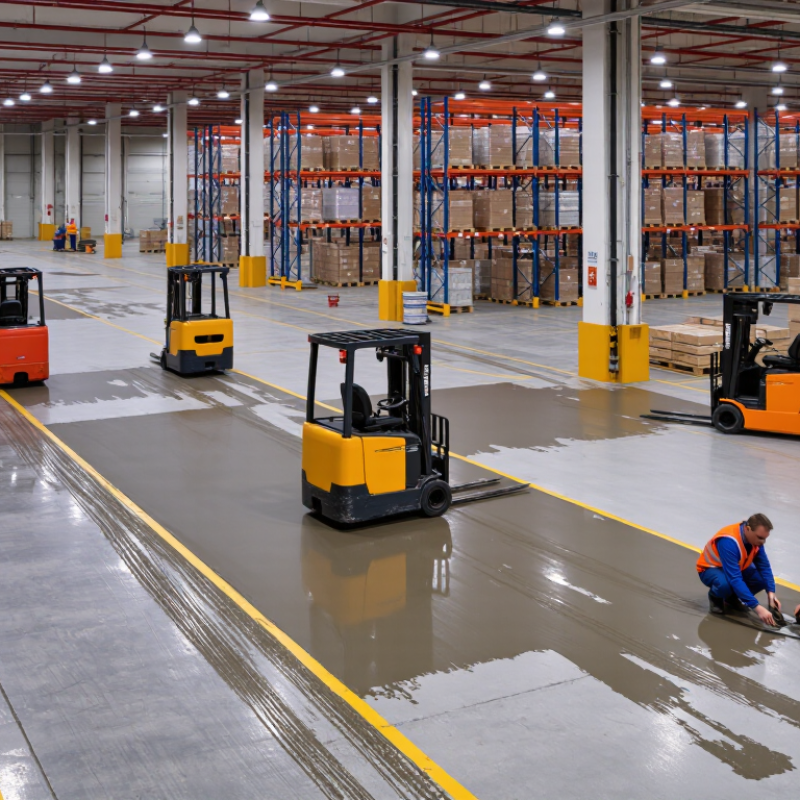
Factories, warehouses, workshops, and food-processing areas use repair mortar where traffic has chipped or worn concrete. Common locations include forklift turning zones, dock edges, machine bases, and aisle joints. Choose a repair material suited to moisture, oils, cleaning chemicals, temperature changes, and impact. Mortar cannot stabilize loose concrete or repair a moving joint. Not every crack qualifies.

Tips: Remove loose concrete, dust, and grease before placement. Follow the specified water ratio and thickness limits. Check the substrate carefully; rushed preparation can lead to debonding. Protect the repair for the stated service time, even if it feels hard sooner. If damage returns, investigate its cause before patching again.

Industrial Floor Repair Mortar: EN 1504-3 Strength Classes

Minimum 28-day compressive strength requirements for repair mortar classes under EN 1504-3.

These classes describe minimum strength requirements, not brand or product performance. Industrial floor repairs may include spalled concrete, damaged joint edges, and localized surface deterioration. Choose a repair material to suit the repair depth, substrate, exposure, and service loads.

Key Criteria for Assessing Chinese Repair Mortar Manufacturers

China Top 10 Industrial Floor Repair Mortar Manufacturers

When comparing Chinese repair mortar manufacturers, look beyond product range and quoted price. Check whether technical data sheets state compressive strength, bond strength, working time, and curing conditions. Ask for recent test reports and confirm that tested formulations match the products supplied. Clear batch records and consistent packaging can reveal how carefully production is controlled.

Assess support for real site conditions. A repair mortar that performs well in a laboratory may behave differently on a damp, dusty, or uneven concrete floor. Ask how the manufacturer advises contractors to prepare the substrate, choose primer, and manage application temperature. Request a small trial batch where practical. A polished catalog can still leave important questions unanswered; this is easy to overlook when delivery deadlines are tight.

Tips: Compare like with like. Record mixing ratios, application thickness, and cure time during trials, then review the results with the supplier’s technical team.

Profiles of 10 Industrial Floor Repair Mortar Manufacturers in China

China’s industrial floor repair mortar manufacturers serve warehouses, workshops, parking structures, and processing plants. A useful profile compares more than product range. It examines repair depth, curing time, substrate preparation, and documented test methods. The ten profiles can represent manufacturers focused on rapid patching, heavy-load floors, abrasion resistance, chemical exposure, damp substrates, cold-weather work, thin overlays, precision grouting, ready-to-use packaging, and project-specific formulations.

Look for practical evidence in each profile. Does the technical sheet state the permitted layer thickness? Are compressive-strength results tied to a clear testing age? Can the supplier explain how to remove loose concrete and control dust before application? Details matter. A mortar may look smooth in a sample tray yet fail where forklift wheels repeatedly turn. Factory capacity and export experience are useful indicators, but they do not guarantee a suitable repair system. Some profiles may also lack comparable test data; that is worth noting, not glossing over.

Tips: Match the mortar to the floor’s actual damage and operating conditions. Check substrate moisture, temperature, and curing requirements on site. Ask for a sample area before scheduling a full repair. Small test patches can reveal issues that a polished brochure cannot.

Common Product Types, Properties, and Applications

Industrial floor repair mortars vary by binder, setting speed, and working environment. Cement-based mortars suit general repairs, such as filling shallow chips and worn patches in concrete. Rapid-hardening grades can reopen busy aisles within hours, but installers must follow the stated mixing and curing times. Polymer-modified mixes generally bond well to prepared concrete and resist abrasion. Epoxy mortars offer strong chemical and mechanical resistance for demanding areas, though surface preparation and moisture control are critical.

Small details matter.

The application should guide product selection. Warehouses often need a durable, traffic-resistant repair around joints and loading zones. Food-processing rooms may require dense, easy-to-clean surfaces that tolerate regular washing. Outdoor slabs face temperature changes and water exposure, so compatibility with the existing concrete matters. Before comparing Chinese suppliers, check technical data for compressive strength, bond strength, working time, and recommended repair depth. Ask how the product performs under the actual site conditions, not just in ideal tests. No mortar fixes poor preparation. Dust, oil, loose concrete, or standing water can weaken even a capable repair, and that is easy to overlook.

How to Compare Manufacturers for Specific Project Needs

Compare manufacturers against the floor’s actual failure mode, not a generic strength claim. A loading bay with turning forklifts needs abrasion resistance and strong bond; a washdown area also needs chemical compatibility and low permeability. Ask for test data on the exact repair mortar, including compressive strength at stated ages, bond strength, shrinkage, and working time. Numbers without test methods are hard to compare. Small details matter.

ICRI Guideline 310.2R describes ten concrete surface-profile grades, from CSP 1 to CSP 10. Ask each supplier to state the required profile and explain how crews can verify it on site. Then compare substrate moisture limits, minimum and maximum placement thickness, curing conditions, and reopening time. ASTM C928/C928M is a useful reference for packaged, rapid-hardening cementitious repair materials; request reports showing which tests were performed and under what conditions. For example, a cold warehouse floor may not match laboratory curing. I would double-check this point. Manufacturers should also provide written application instructions and technical support for mock-ups. A clear warranty helps, but it cannot replace evidence that the product fits the site’s temperature, traffic, and downtime constraints.

China Top 10 Industrial Floor Repair Mortar Manufacturers - How to Compare Manufacturers for Specific Project Needs

Use this project-focused checklist to compare supplier quotations and technical submittals. It contains no company or brand rankings; values below are procurement benchmarks or recognized classification thresholds, not claims about any particular manufacturer.

Comparison Dimension Useful Benchmark or Evidence Best Fit for Specific Project Needs What to Request from Each Manufacturer
Compressive strength class For products classified under EN 1504-3, R3 requires compressive strength of at least 25 MPa; R4 requires at least 45 MPa. R3 may suit many general repairs; consider R4 for higher-load repairs when the design specification calls for it. Current technical data sheet, test method, test age, and independent test report for the exact product.
Bond strength to concrete EN 1504-3 minimum bond requirements are 1.5 MPa for R3 and 2.0 MPa for R4. Important for areas exposed to forklift traffic, vibration, or repeated impact, as well as thin repair layers. Bond-test results and details of substrate preparation, primer use, curing, and test conditions.
Repair depth and layer thickness Permitted thickness is product-specific; compare the stated minimum and maximum thickness per layer with the actual repair depth. Deep spalls, shallow surface defects, vertical edges, and large-area resurfacing may require different formulations or application methods. Application guide showing thickness limits, layering procedure, aggregate requirements, and edge-detail instructions.
Early strength and return to service Compare measured strength at the required reopening time; do not treat “rapid set” as a substitute for test data. Useful for production areas where shutdown time or access restrictions are costly. Strength-development data at stated ages and temperatures, plus written guidance for pedestrian and vehicle traffic reopening.
Abrasion and traffic resistance Request results from a stated abrasion or wear test and compare products tested using the same method and conditions. Prioritize for forklift aisles, loading bays, turning zones, and other high-wear locations. Test method, measured result, specimen age, and any limitations for wheel type, load, or traffic frequency.
Shrinkage and cracking control Compare shrinkage or dimensional-change data only when the test method, curing regime, and specimen conditions are consistent. Especially relevant for broad patches, restrained repairs, and locations where cracking could disrupt operations. Test reports, recommended joint layout, curing procedure, and instructions for connecting the repair to existing concrete.
Chemical exposure resistance Resistance depends on the chemical, concentration, temperature, and exposure duration; there is no single universal chemical-resistance rating. For food processing, workshops, chemical storage, or wash-down areas, match the repair system to the actual exposure. Written compatibility information and test evidence for the specific chemicals and exposure conditions in the project.
Application and curing conditions Use the product data sheet’s stated limits for substrate temperature, ambient temperature, pot life, and curing. Critical for winter repairs, hot environments, night shifts, and sites with limited curing protection. Current installation instructions, mixing-water limits, pot-life data, and curing requirements for expected site conditions.
Substrate preparation and system compatibility Performance depends on suitable concrete preparation and compatibility among the repair mortar, primer, and any protective coating. Important for repairs over contaminated, polished, damp, or previously coated concrete. Preparation specification, primer requirements, moisture limitations, and written compatibility guidance for the complete system.
Quality control and documentation Check traceable batch identification, consistent product documentation, and test reports relevant to the supplied formulation. Important for projects with formal submittal approval, repeat orders, or documented quality requirements. Batch records, current technical and safety data sheets, certificates relevant to the project, and a sample for site evaluation.

Note: EN 1504-3 classification thresholds are standard requirements for the stated classes. Other performance values should be evaluated against the project specification and comparable test methods; verify current product documents and suitability with the manufacturer before purchase.