Why Choose Coal Mine Fans for Efficient Ventilation?
Choosing the right Coal Mine Fans is a practical decision, not a simple equipment purchase. Underground airways change with mining depth, production levels, roadway length, and seasonal conditions. A fan that performs well in one panel may struggle in another.
Dr. Malcolm J. McPherson, a respected mine ventilation engineer and author, wrote, “The primary purpose of mine ventilation is to provide sufficient quantities of air to all parts of the mine where personnel are required to work or travel.” This principle still guides responsible ventilation planning. Coal Mine Fans help move fresh air through working areas, dilute methane and dust, and remove heat from enclosed spaces. Axial fans often support high-volume airflow, while centrifugal fans can provide stronger pressure for difficult resistance conditions.
The details matter.
Engineers must examine airflow demand, system resistance, fan efficiency, noise, energy use, and maintenance access. Monitoring equipment should verify actual performance instead of relying only on design figures. A pressure gauge, airflow sensor, and regular inspection can reveal problems before they become serious.
Still, fan selection is not perfect. Real mines contain leakage, damaged stoppings, changing headings, and unexpected resistance. Even a powerful fan cannot correct poor system design. This is where experience becomes valuable. A careful ventilation review should combine measured data, manufacturer curves, site knowledge, and applicable safety requirements. Coal Mine Fans can improve efficiency and working conditions, but only when installed, operated, and maintained as part of a complete ventilation system.
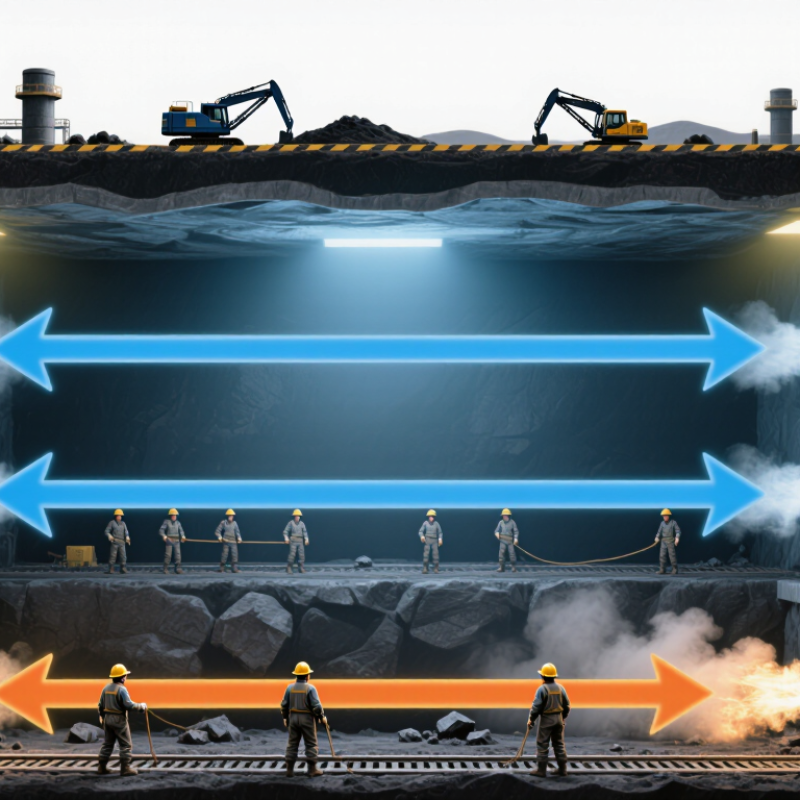
Define Ventilation Demand: Airflow, Resistance, and the 1.0% Methane Limit
Why Choose Coal Mine Fans for Efficient Ventilation?
Coal mine fans must match real ventilation demand, not a guessed airflow figure. Demand begins with methane dilution, worker locations, equipment heat, and available oxygen. Under U.S. MSHA regulation 30 CFR 75.323, methane reaching 1.0% requires corrective action, while 2.0% requires withdrawal from affected areas. That margin is narrow. A reliable design keeps methane well below the limit during production changes, not only during normal shifts.
Airflow is only half the calculation. Resistance comes from entries, stoppings, regulators, bends, and leakage. NIOSH ventilation engineering guidance applies Atkinson’s relationship: pressure loss rises with the square of airflow. A 20% airflow increase can demand roughly 44% more pressure. The fan’s duty point must therefore satisfy both quantity and pressure. MSHA inspection guidance also emphasizes regular ventilation measurements, methane checks, and leakage control. Field conditions are rarely tidy. A damaged stopping can quietly change the whole network.
Tips: Record airflow and pressure at fixed survey points. Compare readings after cutting patterns change. Test fan performance against the actual mine resistance curve. Keep alarms calibrated. A spreadsheet can expose errors, but it cannot replace an underground inspection. I would also review the design after every major airway change; this step is easy to postpone, and that is a weakness.
Sources: U.S. MSHA, 30 CFR 75.323 and Coal Mine Safety and Health Inspection Procedures Handbook; NIOSH mine ventilation engineering guidance.
Compare Axial and Centrifugal Fans at 80–90% Operating Efficiency
Why Choose Coal Mine Fans for Efficient Ventilation?
At 80–90% operating efficiency, coal mine fans can move air effectively without wasting excessive power. The U.S. Department of Energy’s Improving Fan System Performance report identifies fans as major industrial electricity users, sometimes approaching 20% of facility consumption. This makes correct selection financially important underground. Axial fans suit high airflow and relatively low resistance. Their compact layout can simplify large-volume ventilation. Centrifugal fans usually handle higher static pressure more steadily. They are useful when ducts, bends, regulators, and dust create stronger resistance.
Efficiency figures need careful interpretation. AMCA 210 and ANSI/AMCA 300 establish laboratory methods for measuring airflow, pressure, and sound. However, mine conditions rarely match clean laboratory conditions. A fan rated at 88% may perform differently after inlet turbulence, leakage, or dust accumulation. MSHA ventilation guidance emphasizes adequate airflow and effective methane control, while field engineers must verify pressure and quantity at the working face. A neglected detail matters. Wrong system resistance can erase the expected energy savings.
Tips: Measure airflow and static pressure at several operating points, not only at the peak-efficiency mark. Check the fan curve against the complete mine resistance curve. Axial units deserve attention during unstable operation, while centrifugal units need regular inspection of impellers and housings. Use variable-speed control carefully; lower speed can reduce power, but poor control may create insufficient face ventilation. Recheck readings after seasonal changes. Underground reality is imperfect. That deserves honest testing.
Why Choose Coal Mine Fans for Efficient Ventilation?
Axial and centrifugal fans can both operate efficiently when correctly matched to the mine's airflow and pressure requirements. This representative engineering comparison shows typical efficiency performance across three operating points.
How to read the chart: Axial fans are commonly selected for high-volume, relatively low-pressure ventilation, while centrifugal fans are often preferred where higher pressure and robust resistance to system changes are required. Actual efficiency depends on fan size, impeller design, system resistance, and the selected duty point.
Match Fan Pressure and Airflow to Mine Resistance Curves
Why Choose Coal Mine Fans for Efficient Ventilation?
Selecting a coal mine fan begins with the mine resistance curve, not a catalog airflow figure. The curve shows how pressure demand rises as airflow increases through shafts, roadways, stoppings, bends, and regulators. A fan operates where its performance curve meets that resistance curve. That intersection matters more than a maximum airflow claim.
Ventilation engineers should measure actual resistance whenever possible. Gas monitoring, pressure readings, leakage checks, and airflow surveys reveal conditions that drawings may miss. A fan with excessive pressure can waste energy and increase leakage through damaged stoppings. A weak fan may leave working areas short of fresh air. Small changes matter underground. Door openings, new headings, and dust buildup can shift the system curve.
Variable-speed control can help match changing production demands. Parallel fans may increase airflow, while series arrangements provide higher pressure for restrictive networks. However, these configurations require careful analysis of stability, operating range, and emergency conditions. The fan’s duty point should remain clear of unstable regions. That detail is easy to overlook.
A neat curve on paper can still mislead. Measurements may be incomplete, and resistance estimates may age quickly. Experienced teams should compare predicted and observed airflow after installation. They should also document every adjustment. A reliable selection process connects fan pressure, airflow, motor capacity, noise, and maintenance access to real mine conditions, not ideal assumptions.
Why Choose Coal Mine Fans for Efficient Ventilation? - Match Fan Pressure and Airflow to Mine Resistance Curves
| Ventilation Case | Required Airflow
(m³/s) | Mine Resistance
R [Pa/(m³/s)²] | Required Pressure
ΔP = RQ² (Pa) | Suitable Fan Arrangement | Fan Efficiency
(%) | Estimated Input Power
(kW) | Efficiency and Safety Consideration |
| Development Heading | 100 | 0.080 | 800 | Single adjustable-speed auxiliary fan | 72 | 112 | Use variable-speed control to follow changing face resistance and limit unnecessary air volume. |
| Single Production District | 150 | 0.060 | 1,350 | Main axial fan with duty-point adjustment | 78 | 260 | Select the operating point on the stable portion of the fan curve, away from stall and excessive shut-off pressure. |
| Multiple Working Districts | 200 | 0.045 | 1,800 | Parallel main fans with independent isolation capability | 80 | 450 | Parallel operation can increase total airflow while maintaining flexibility for inspection and maintenance. |
| Deep or High-Resistance Network | 250 | 0.035 | 2,188 | High-pressure centrifugal or high-pressure axial fan | 82 | 667 | Confirm motor capacity, emergency power requirements, noise limits, and the fan’s certified operating range. |
| Future Expansion Allowance | 275 | 0.035 | 2,647 | Variable-speed fan with documented reserve capacity | 80 | 908 | Avoid excessive oversizing; use measured network resistance and future mine plans to define the reserve requirement. |
Engineering basis: Mine resistance is represented by the quadratic relationship ΔP = RQ², where ΔP is pressure in pascals, R is resistance, and Q is airflow in cubic metres per second. The fan operating point is where the fan pressure–airflow curve intersects the mine resistance curve.
Power calculation: Estimated input power = (ΔP × Q) ÷ η, where η is the overall fan efficiency expressed as a decimal. Values are calculated operating examples and should be verified using site measurements, ventilation-network modelling, statutory requirements, gas-control plans, and certified fan performance data.
Design reminder: Air quantity, pressure, fan duty, emergency operation, fire resistance, methane control, electrical classification, and permissible equipment requirements must be confirmed by a qualified mine ventilation engineer.
Evaluate Redundancy, Reversal, and 24/7 Main-Fan Reliability
In underground coal mining, ventilation is not a background utility; it is a working safety system. A main fan must move predictable air through changing headings, haul roads, and return entries. Redundancy matters when a motor trips during a wet night shift. A standby fan, separate power path, and tested changeover can prevent airflow from collapsing. Operators should verify actual duty points, not trust catalog figures. Air density, dust loading, and resistance can alter performance underground. Small errors become expensive.
Reversal capability deserves practical testing, not a line in a specification sheet. During an emergency, the fan may need to reverse airflow and clear smoke or contaminated air from selected routes. The control sequence should be interlocked, documented, and rehearsed with mine personnel. Watch the dampers. Confirm position feedback. A reversal that takes too long can create confusion near refuge areas. Yet rapid reversal is not automatically safer; sudden pressure changes may disturb doors, stoppings, and auxiliary ventilation. Engineers need measured limits for each circuit.
24/7 reliability depends on maintenance discipline as much as equipment design. Bearings need vibration checks, temperatures need trending, and belts or couplings require inspection before failure signs grow obvious. Keep critical spares nearby. Record every alarm and transfer test. Real sites are imperfect. Sensors drift, batteries weaken, and crews miss checks under production pressure. Independent audits and emergency drills expose those gaps. Each shift should leave clear records for the next crew, including unusual noise, delayed transfers, or unstable airflow.